
This last two weeks' posts have been reflecting on thoughts about Family Systems Theory, which we've been reading about in my Marriage & Family Counseling class. Go back and read the context if you're just now happening across these posts...
There is a widespread assumption that the key to a successful marriage is finding the "right match." A more accurate perspective is that it is not the ingredients of the mixture but the emotional crucible into which they are poured."
"Emphasizing compatibility is also misleading because it tends to isolate the marriage relationship from the two emotional fields in which it is always situated-- the nuclear family and the extended families of both partners."
How do these ideas reflect on eharmony.com; match.com?
Tuesday, September 21, 2010


Monday, September 20, 2010
Happy Birthday baby
Many memories, many miles, walking together with you.
Newlyweds, Great Wall, 1999

1st home, Dallas, 2002

New daddy, Dallas, 2003

The Big Texan, Amarillo, 2005

The man loves a campfire, Lake City, CO, 2005

Daddy's strong arms, 2005

New life in Singapore, 2005

Johor Bahru, 2006

Desaru Beach, 2006

Christmas, 2006

Koh Samui, 2008

Rocky Mountain National Park, 2009

Goodbye to Beijing, 2010

Saint Louis, September 2010

Newlyweds, Great Wall, 1999

1st home, Dallas, 2002

New daddy, Dallas, 2003

The Big Texan, Amarillo, 2005

The man loves a campfire, Lake City, CO, 2005

Daddy's strong arms, 2005

New life in Singapore, 2005
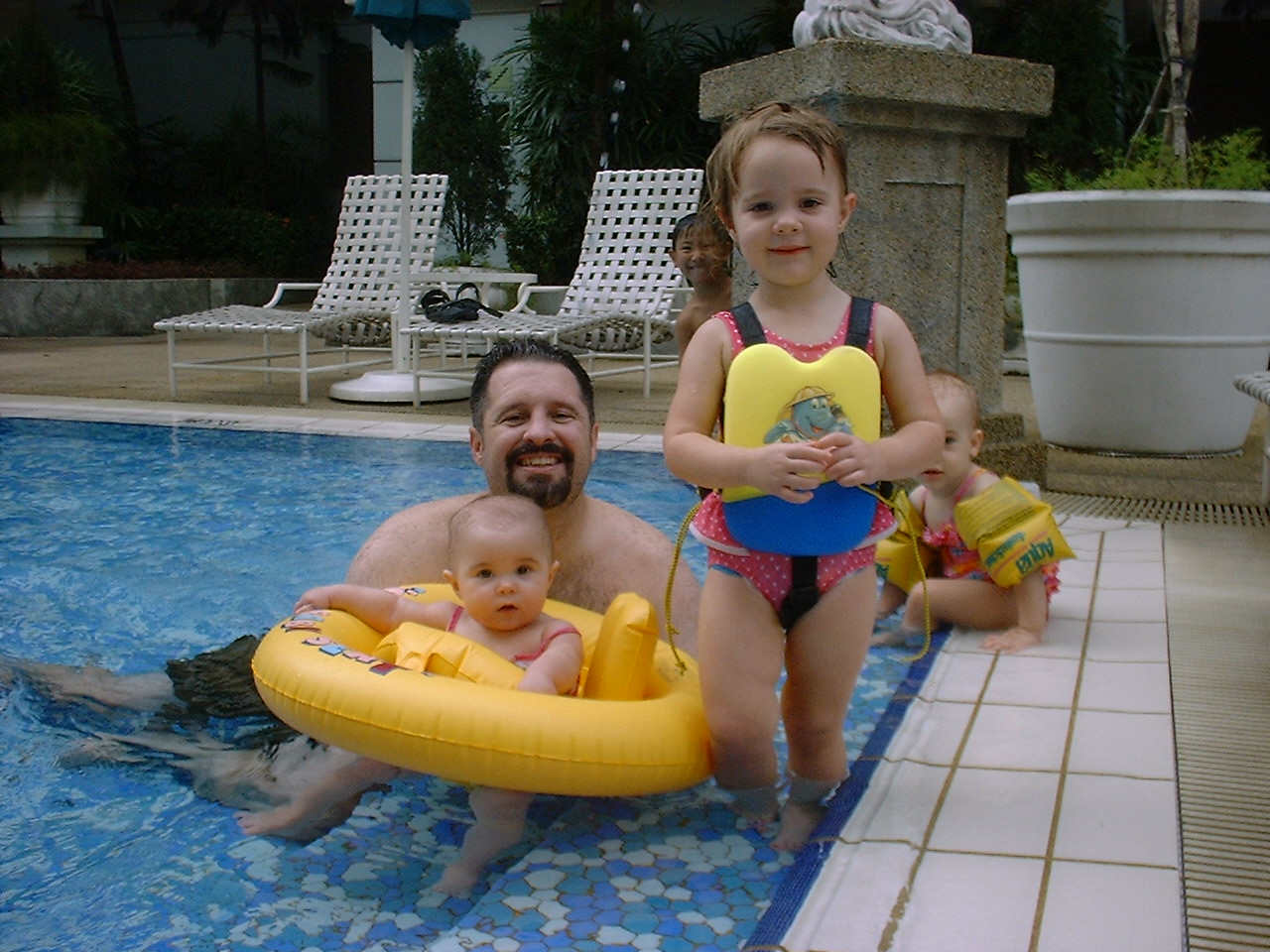
Johor Bahru, 2006

Desaru Beach, 2006

Christmas, 2006

Koh Samui, 2008

Rocky Mountain National Park, 2009

Goodbye to Beijing, 2010

Saint Louis, September 2010

Friday, September 17, 2010
The Paradox of Seriousness and Playfulness
How many times are our struggles made worse by our "freaking out" about our having a struggle?
Here's a thought I've found very helpful, for my own tendency towards seriousness:
"The seriousness with which families approach their problems can be more the cause of the difficulties than the effect of the problems… Seriousness presents a paradox. If family members are not serious about their responsibilities, the family may become unstable and chaotic. But seriousness can also be destructive. Seriousness is more than an attitude; it is a total orientation, a way of thinking embedded in constant, chronic anxiety. It is a lack of flexibility in response, a narrow repertoire of approaches, persistent efforts to try harder, and a loss of perspective."
"Families that evidence such seriousness are as if surrounded by volatile fumes of anxiety, and any small incident can cause a flare-up. They will always assume that it was the incident that created the problem, but it is the way they relate and think that gives nay incident its inflammatory power. If changes can be made in such a noxious atmosphere then the fumes of anxiety disperse, and the sparking incidents of life lose their explosive potential."
"The antidote to seriousness is the capacity to be playful."
What do you do to cultivate a healthy sense of play?
Here's a thought I've found very helpful, for my own tendency towards seriousness:
"The seriousness with which families approach their problems can be more the cause of the difficulties than the effect of the problems… Seriousness presents a paradox. If family members are not serious about their responsibilities, the family may become unstable and chaotic. But seriousness can also be destructive. Seriousness is more than an attitude; it is a total orientation, a way of thinking embedded in constant, chronic anxiety. It is a lack of flexibility in response, a narrow repertoire of approaches, persistent efforts to try harder, and a loss of perspective."
"Families that evidence such seriousness are as if surrounded by volatile fumes of anxiety, and any small incident can cause a flare-up. They will always assume that it was the incident that created the problem, but it is the way they relate and think that gives nay incident its inflammatory power. If changes can be made in such a noxious atmosphere then the fumes of anxiety disperse, and the sparking incidents of life lose their explosive potential."
"The antidote to seriousness is the capacity to be playful."
What do you do to cultivate a healthy sense of play?
Thursday, September 16, 2010
What is Your Pain Threshold?
Taking Responsibility for Your Own Life, Emotions, & Actions
Thresholds for both physical and emotional pain are lower when we are functioning (with an unhealthy) dependency. Where members of a family are too quick to spare another pain, the resulting dependency tends to make the other's threshold fall. In addition, he or she will become addicted to having pain relieved through someone else's functioning.
"We cannot make another family member responsible by trying to make him or her more responsible. The very act of trying to make others responsible preempts their own responsibility. This is equally true whether the issue is study habits, drinking, or failure to take responsibility for one's daily life. Harsh scolding generally should not be seen as inflicting pain. It often succeeds in taking the sting out of their indolence, thus taking away the stimulus for motivation."
"There is however a way to be our brother's keeper… it require one to non-anxiously tolerate pain, and sometimes even to stimulate pain, thus forcing the other to increase his or her threshold."
Here's a great quote:
"Sticking someone with the pain of responsibility for his own her own life is far more "sobering" than giving the person black coffee afterwards."
Wednesday, September 15, 2010
Making Relational Changes
...the kind that lasts!
Dr. Zink has said that lasting change to relational patterns happens in 3 steps:
1. You make a change. (Say you set a boundary... you will no longer step in and save the day in "x" way)
2. People you are close to react to that change. (You are NEEDED. They will DIE without you. They are angry. They are subtly manipulative. They pull away. They are cold. At 11:59, they are still not taking responsibility for themselves.)
3. You maintain the change.
Most people can complete #1, but after #2 happens, it is extremely difficult to maintain one's resolve when others are seeking to make sure you maintain your position in the relational system.
"Most family members would prefer peace to progress... Many family members or leaders can take the very first step of trying not to respond with their usual adaptive or reactive patterns. Very few, however, can maintain their resolve to hold that position when symptoms become more intense. This increases their anxiety, sabotages their resolve, and begins to draw them back into the triangle again."
Makes me wonder how much "true change" (i.e. "step 3 change") I've actually experienced/maintained in my life!
Dr. Zink has said that lasting change to relational patterns happens in 3 steps:
1. You make a change. (Say you set a boundary... you will no longer step in and save the day in "x" way)
2. People you are close to react to that change. (You are NEEDED. They will DIE without you. They are angry. They are subtly manipulative. They pull away. They are cold. At 11:59, they are still not taking responsibility for themselves.)
3. You maintain the change.
Most people can complete #1, but after #2 happens, it is extremely difficult to maintain one's resolve when others are seeking to make sure you maintain your position in the relational system.
"Most family members would prefer peace to progress... Many family members or leaders can take the very first step of trying not to respond with their usual adaptive or reactive patterns. Very few, however, can maintain their resolve to hold that position when symptoms become more intense. This increases their anxiety, sabotages their resolve, and begins to draw them back into the triangle again."
Makes me wonder how much "true change" (i.e. "step 3 change") I've actually experienced/maintained in my life!
Tuesday, September 14, 2010
Distancing
Distancing … Dealing With Anxiety in Relationships
We all do it, don't we?
"When family members (or people in close relationships) use physical distance to solve problems of emotional interdependency, the result is always temporary, or includes a transference of the problem to another relationship system."
"Most family members think of distance as a physical category rather than an emotional one. Accordingly, when they want more separation, they tend to resort to physical solutions. A husband who finds a wife's constant anxiety disturbing may spend more time on the internet; a wife who wants to get away from her perpetually critical husband may start to take half-hour showers, etc…"
"While such efforts often bring relief, generally the require a great deal of energy to maintain the relief, and in many situations, the same intensity just surfaces elsewhere."
"Distancing comes about because there is not enough distance to begin with. Marriage partners may separate because they have grown distant, but most couples probably separate because they are not able to achieve any separation at all."
"Getting distance must go beyond obtaining physical space. The capacity to define self in a relationship, and to control one's own reactive mechanisms, also creates space. The opposite is equally true: the quickest way to destroy distance is to over-function anxiously in another's space. Emotional distance must be measured in terms of resiliency rather than inches."
Have you seen this play out in your relationships?
We all do it, don't we?
"When family members (or people in close relationships) use physical distance to solve problems of emotional interdependency, the result is always temporary, or includes a transference of the problem to another relationship system."
"Most family members think of distance as a physical category rather than an emotional one. Accordingly, when they want more separation, they tend to resort to physical solutions. A husband who finds a wife's constant anxiety disturbing may spend more time on the internet; a wife who wants to get away from her perpetually critical husband may start to take half-hour showers, etc…"
"While such efforts often bring relief, generally the require a great deal of energy to maintain the relief, and in many situations, the same intensity just surfaces elsewhere."
"Distancing comes about because there is not enough distance to begin with. Marriage partners may separate because they have grown distant, but most couples probably separate because they are not able to achieve any separation at all."
"Getting distance must go beyond obtaining physical space. The capacity to define self in a relationship, and to control one's own reactive mechanisms, also creates space. The opposite is equally true: the quickest way to destroy distance is to over-function anxiously in another's space. Emotional distance must be measured in terms of resiliency rather than inches."
Have you seen this play out in your relationships?
Monday, September 13, 2010
Emotional Geometry
Emotional Triangles, that is:
Have you ever sought to help two people come together who are struggling in their relationship? Or ever sought to help someone see and own the harm they are causing themselves?
"When any two parts of a system become uncomfortable with one another, they will "triangle in" or focus upon a third person, or issue, as a way of stability their own relationship with one another. When individuals try to change the relationship of two others, they "triangle" themselves into that relationship -- and often stabilize the very situation they were trying to change."
It has been said "What Peter says about Paul tells you more about Peter than it does about Paul." In the concept of an emotional triangle, What Peter says to you about his relationship with Paul has to do with his relationship with you."
1. The relationship of any two members is kept in balance by the way a third party relates
to each of them.
2. If one IS the third party in an emotional triangle, it is generally not possible to bring change by trying to change their relationship directly. Attempts to change the relationship often trigger "homeostatic forces" which convert these efforts to their opposite intent. Trying harder to bring two people together, or a person and "taking responsibility for their issue" together, will generally maintain or increase the distance between them.
3. When a third party tries unsuccessfully to change the relationship of the other two, the more likely it is that the third party will wind up with the stress for the other two. This helps explain why the "dysfunctional member" in many families is often NOT the weakest person in the system, but on the contrary, often the one taking responsibility for the entire system.
4. We can only change a relationship to which we belong. Therefore the way to bring change to the relationship of two others is try to maintain a well-defined relationship with each, and avoid the responsibility for their relationship with one another. To the extent we can maintain a "non-anxious presence" in a triangle, this has the potential to modify the anxiety in the others. The problem is to be both non-anxious and present. Anyone can keep his or her own anxiety down by distancing, but that usually preserves the triangle.
I think this is fascinating! You?
Friday, September 10, 2010
Standing On Your Own Branch
This post is flowing from the previous posts started 2 days ago... go back and read those first if you'd like the background.
Differentiation
This captures the idea that the more a person is able to "stand on their own", owning their own thoughts and feelings as an individual, the more meaningfully a person can connect in other relationships. We all start out "undifferentiated"-- young children see the world as their parents interpret it for them... here I'm not so much talking about "views" as I am "emotional responses to life." But if we remain this way, we are not 'close to our family' as much as we are 'stuck to our family.'
"This is the capacity of a family member or member of close relational group, to define his or her own life's goals and values apart from surrounding togetherness pressures, to say "I" when others are demanding "you" and "we". It includes the capacity to maintain a non-anxious presence in the midst of anxious systems, to take maximum responsibility for one's own life and emotional being."
Imagine two people who are fused to the ends of a twig. If one person is shaking the twig, the other will fall. But imagine two people who are connected to two branches shooting off the same twig. If one shakes, the other will feel the jolt, but not be torn from its own branch.
"When two people are stuck to the same twig, so to speak, the nature of the relationship may appear close. They may appear together, but they are really stuck together. They will wind up either perpetually in conflict, because they are so reactive to one another, or they will have a homey togetherness achieved through the total sacrifice of their own selves."
How do you see this play out in your family--both the family you grew up in, and with your own nuclear family?
Differentiation
This captures the idea that the more a person is able to "stand on their own", owning their own thoughts and feelings as an individual, the more meaningfully a person can connect in other relationships. We all start out "undifferentiated"-- young children see the world as their parents interpret it for them... here I'm not so much talking about "views" as I am "emotional responses to life." But if we remain this way, we are not 'close to our family' as much as we are 'stuck to our family.'
"This is the capacity of a family member or member of close relational group, to define his or her own life's goals and values apart from surrounding togetherness pressures, to say "I" when others are demanding "you" and "we". It includes the capacity to maintain a non-anxious presence in the midst of anxious systems, to take maximum responsibility for one's own life and emotional being."
Imagine two people who are fused to the ends of a twig. If one person is shaking the twig, the other will fall. But imagine two people who are connected to two branches shooting off the same twig. If one shakes, the other will feel the jolt, but not be torn from its own branch.
"When two people are stuck to the same twig, so to speak, the nature of the relationship may appear close. They may appear together, but they are really stuck together. They will wind up either perpetually in conflict, because they are so reactive to one another, or they will have a homey togetherness achieved through the total sacrifice of their own selves."
How do you see this play out in your family--both the family you grew up in, and with your own nuclear family?
Thursday, September 09, 2010
Who is the "Patient"?
Read the previous post before reading this one.
Every family has stress pop up somewhere, sometime. Often, it is common for the family to identify this stress in a "problem member" as an isolated incident or unit, but that person's problem is more reflective of the system.
When someone comes to see a counselor, this person can be called the "identified patient" who is often seen as the "sick one." In family systems thinking, this family member with the most obvious symptom is NOT to be seen not as the "sick one" but as the one in whom the family's stress has surfaced…
The family's stress can surface not just in a "troubled" member, but also a "superpositive" or "super-functioning" member, such as an strikingly high achiever, or an overly responsible child.
What do you think of this idea?
Wednesday, September 08, 2010
Chaos at 6:30?

Today's picture- compliments of one of my favorite thought-provoking, pithy blog posters, twentytwowords.com.
Your Family Has a System
I have been especially intrigued with my Marriage & Family Counseling class, which I feel is helping me give words to what I believe about where our relational struggles come from. This next series of posts contain quotes and thoughts about Family Systems Theory… I find it fascinating! Wish I could sit down and chat about this with so many of you out there who are interested in counseling... though its implications go far beyond counseling!
Much of this material comes from Generation to Generation, a book written by Edwin Friedman.
Family Systems
Every family operates in a system, where the members of the family adopt particular roles that play out in the way that family communicates & relates. Your position continues to play an integral role in the way you communicate and function in relationships for the rest of your life.
Seeking to change in a particular struggle as an individual without understanding the position you play in your relationships... won't work!
"Our individual problems have more to do with our relational networks, the makeup of others' personalities, where we stand within the relational systems, and how we function within that position."
The family system is highly resistant to change! Here is an example my friends in China can appreciate:
"Under every sink (in the US and not in China!) is a vertical looped cylinder. The purpose of this trap pipe is to prevent noxious gasses from entering the system. Every time it fills up or "chokes" on the influx, it saves the house and the entire network. But now let us animate those pipes. Suppose one of those traps under a sink decided to straighten itself out. We may well imagine the increased anxiety in the others, some of which might well "go through the roof." And it would seem right to guess that they would do everything they could to pressure that newly autonomous pipe not to straighten itself out, or, if that were too late, to bend it back in shape again."
In other words, the relational networks you developed in are highly resistant to you seeking to give up your position in the network! This plays out, not just in nuclear families, but extended families, in work and organizational environments, and groups (like churches) that function in ongoing relationships.
"Often such systems can have a lot of togetherness, but the "circuit-breaker" effect of self (or the straight pipe in the previous example), necessary for a system to survive crisis, is missing. It has less togetherness than stuck-togetherness."
Agree? Disagree? Thoughts?
Much of this material comes from Generation to Generation, a book written by Edwin Friedman.
Family Systems
Every family operates in a system, where the members of the family adopt particular roles that play out in the way that family communicates & relates. Your position continues to play an integral role in the way you communicate and function in relationships for the rest of your life.
Seeking to change in a particular struggle as an individual without understanding the position you play in your relationships... won't work!
"Our individual problems have more to do with our relational networks, the makeup of others' personalities, where we stand within the relational systems, and how we function within that position."
The family system is highly resistant to change! Here is an example my friends in China can appreciate:
"Under every sink (in the US and not in China!) is a vertical looped cylinder. The purpose of this trap pipe is to prevent noxious gasses from entering the system. Every time it fills up or "chokes" on the influx, it saves the house and the entire network. But now let us animate those pipes. Suppose one of those traps under a sink decided to straighten itself out. We may well imagine the increased anxiety in the others, some of which might well "go through the roof." And it would seem right to guess that they would do everything they could to pressure that newly autonomous pipe not to straighten itself out, or, if that were too late, to bend it back in shape again."
In other words, the relational networks you developed in are highly resistant to you seeking to give up your position in the network! This plays out, not just in nuclear families, but extended families, in work and organizational environments, and groups (like churches) that function in ongoing relationships.
"Often such systems can have a lot of togetherness, but the "circuit-breaker" effect of self (or the straight pipe in the previous example), necessary for a system to survive crisis, is missing. It has less togetherness than stuck-togetherness."
Agree? Disagree? Thoughts?
Thursday, September 02, 2010
Anxiety
"Families agree not to talk about anxiety, in an unspoken pact of silence. Anxiety is always there, whether we know it or name it. What tells you if you are maturing, non-reactive, but responsive, is what you do with that anxiety. When you feel it, can you keep thinking anyway? Or does it incapacitate you? Can you embrace what's there and name it? If you can't name it, it's still driving you. The fuel for family dynamics is anxiety." --Dr. Dan Zink
Why Do We Do Community?
Why do we do community?
Because God didn't say "I will be your God, and you will be my one and only person." He said, "I will be your God, and you will be my PEOPLE."
Why do we do community?
Because outsiders don't say "Wow! Look at the power of their arguments!" They say, "Look how they love each other."
What are some other reasons?
(Because sometimes, in the messiness of it, you need to remind yourself:)
Because God didn't say "I will be your God, and you will be my one and only person." He said, "I will be your God, and you will be my PEOPLE."
Why do we do community?
Because outsiders don't say "Wow! Look at the power of their arguments!" They say, "Look how they love each other."
What are some other reasons?
(Because sometimes, in the messiness of it, you need to remind yourself:)
Tuesday, August 31, 2010
What We Fail to Notice
Think about this quote in terms of life change:
The range of what we think and do is limited by what we fail to notice. And because we fail to notice what we don't notice, there is little we can do to change; until we notice how failing to notice shapes our thoughts and deeds. --Daniel Goleman
It begs the question: How can you begin to notice what you fail to notice? Or to put it another way, how can you begin to see your blindness?
Thoughts?
This Semester's Fun
You were starting to think I only had picture updates, right?
So here's what I'm thinking about the blog this year. My school schedule is very full time, but I'd love to use the blog to process snippets of information, new ideas, quotes, and questions I'm asking myself throughout my studies. If you want to follow along, here are the classes and books I'm reading this semester--
God & His Word- (I really liked this prof! He is just what you'd (or at least I'd) expect a good theology prof to be. Spent the whole first class talking about how to read a book and think reflectively about what you read. Might sound boring-- it was excellent!)
Proper Confidence- Lesslie Newbigin
Epic of Eden- The Epic of Eden
Far as the Curse is Found- Michael Williams
The Mission of God- Christopher Wright
Creation Regained- Al Wolters
Intro to Counseling- this is the one class I haven't had; it meets for the first time today. This prof, Dr. Richard Winter, first got his MD, spent years at L'Abri in Switzerland... then became a counseling prof. I'm sure there's details I'm missing, but very unique combination! Very intrigued by all the angels he is hitting- medicine, spirituality, counseling...love the combo.
Pastor’s Guide to Psychological Disorders and Treatments- Johnson/Johnson
Strategic Pastoral Counseling- Benner
Healing Path- Allender
Perfecting Ourselves to Death- Winter
Emotionally Healthy Spirituality- Scazzero
Marriage & Family Counseling- (this class is taught by Dr. Dan Zink, who has his own counseling practice. I could tell in class 1-- I'm really going to like this guy's style. Very life application and story oriented; very heart-engaging and wise.)
Extraordinary Relationships- R. Gilbert
Hold Me Tight- Sue Johnson
Take Back Your Marriage- W. Doherty
Safe Haven Marriage- A. Hart & S Hart Morris
What am I Feeling?- J. Gottman
A Family Genogram Workbook- I Galindo
Educational & Psychological Measurements- (this class is about the purpose and how to of using assessment tests to guide you as a counselor in learning about clients. After being exposed to LEAF and with all the assessment tools we use in our company, I'm really excited to learn about these tools... aside from the mathematical statistics part! This prof is in his 70's and has been an LPC all his life. So perfect for this class- he is actually passionate about the development of tests.)
Essentials of Testing & Assessment: A Practical Guide for Counselors- Neukrug
Sense and Sexuality- (this class is a weekend course in October so I don't know much about it yet.)
Sexuality and Holy Longing, McMinn
Soul Virgins, Rosenau/Wilson
If any of these topics/books/readings, etc... interest you, join in the discussion!
So excited to dive in!
So here's what I'm thinking about the blog this year. My school schedule is very full time, but I'd love to use the blog to process snippets of information, new ideas, quotes, and questions I'm asking myself throughout my studies. If you want to follow along, here are the classes and books I'm reading this semester--
God & His Word- (I really liked this prof! He is just what you'd (or at least I'd) expect a good theology prof to be. Spent the whole first class talking about how to read a book and think reflectively about what you read. Might sound boring-- it was excellent!)
Proper Confidence- Lesslie Newbigin
Epic of Eden- The Epic of Eden
Far as the Curse is Found- Michael Williams
The Mission of God- Christopher Wright
Creation Regained- Al Wolters
Intro to Counseling- this is the one class I haven't had; it meets for the first time today. This prof, Dr. Richard Winter, first got his MD, spent years at L'Abri in Switzerland... then became a counseling prof. I'm sure there's details I'm missing, but very unique combination! Very intrigued by all the angels he is hitting- medicine, spirituality, counseling...love the combo.
Pastor’s Guide to Psychological Disorders and Treatments- Johnson/Johnson
Strategic Pastoral Counseling- Benner
Healing Path- Allender
Perfecting Ourselves to Death- Winter
Emotionally Healthy Spirituality- Scazzero
Marriage & Family Counseling- (this class is taught by Dr. Dan Zink, who has his own counseling practice. I could tell in class 1-- I'm really going to like this guy's style. Very life application and story oriented; very heart-engaging and wise.)
Extraordinary Relationships- R. Gilbert
Hold Me Tight- Sue Johnson
Take Back Your Marriage- W. Doherty
Safe Haven Marriage- A. Hart & S Hart Morris
What am I Feeling?- J. Gottman
A Family Genogram Workbook- I Galindo
Educational & Psychological Measurements- (this class is about the purpose and how to of using assessment tests to guide you as a counselor in learning about clients. After being exposed to LEAF and with all the assessment tools we use in our company, I'm really excited to learn about these tools... aside from the mathematical statistics part! This prof is in his 70's and has been an LPC all his life. So perfect for this class- he is actually passionate about the development of tests.)
Essentials of Testing & Assessment: A Practical Guide for Counselors- Neukrug
Sense and Sexuality- (this class is a weekend course in October so I don't know much about it yet.)
Sexuality and Holy Longing, McMinn
Soul Virgins, Rosenau/Wilson
If any of these topics/books/readings, etc... interest you, join in the discussion!
So excited to dive in!
Subscribe to:
Posts (Atom)


